
Unit testing is neither automatically essential nor a waste of time. Its value depends on the risks a change creates and whether a test gives the team useful confidence without adding unnecessary upkeep. The questions to ask a software developer should reveal how they make that trade-off, not just whether they write tests.
It’s reasonable to care about delivery speed as well as code quality. A thoughtful developer can explain what they test, how they handle failures, and when another kind of check makes more sense. Their answers should show a practical process, not a one-size-fits-all rule.
This guide covers questions that reveal how a developer approaches testing, APIs, personal projects, open-source contributions, and Agile work. You’ll also find ways to explore technical judgment and collaboration through concrete examples, helping you assess how someone thinks and works before choosing the right fit for your project.
Key Takeaways
- Look for developers who can explain technical ideas in plain language and connect them to practical business needs.
- Use personal projects and open-source work to explore how a developer learns, documents decisions, and responds when something goes wrong.
- Ask how Agile practices shape feedback, teamwork, and priorities as a project evolves.
- Focus technical interview questions on how candidates reason through problems, not only whether they can produce a working answer.
1. How would you explain APIs to non-technical stakeholders?
An API lets separate software systems exchange information through agreed requests. Ask the developer to explain it with a familiar example, such as a booking website sending a reservation to a calendar. A clear explanation connects the technical function to a business outcome, such as reducing manual updates.
Follow up with: “What information moves between the systems, and what happens if one system is unavailable?” A strong answer might describe a booking request, the response confirming its status, and a fallback if the calendar can’t respond. This reveals how the developer explains dependencies and handles failures.
Use a technical challenge to explore engineering judgment: “Tell me about a time a system integration caused a problem.” Listen for the challenge, the steps taken to diagnose it, and the outcome. For example, a developer might explain how they traced missing order details to a mismatch between two systems.
Ask directly about their coding process and tools: “How do you plan, review, test, and track code changes?” A useful answer names the steps and tools involved, then explains how they keep the team aligned. Ask how the process differs for a small update and a new feature.
For maintenance, support, and bug fixes, ask: “How are issues reported, prioritised, fixed, and tested?” A practical example, such as reproducing a checkout error before changing code, shows how the developer approaches a fix while considering its effects.
Ask how the developer protects data, privacy, and intellectual property. For example: “Who can access customer records, and how are project files and code ownership handled?” Look for a clear explanation of access controls, data handling, and agreed ownership terms.
Red flags include vague answers, dismissing testing, or blaming others without explaining their own actions. If a candidate can’t describe how they handled a specific bug, ask for an example and what they learned.
To assess how they learn, ask how they approach unfamiliar technology or a beta tool. A grounded answer may describe reading the documentation, building a small test, and comparing the results with project needs before adopting it.
Keep the interview conversational. Ask one follow-up after each answer, such as “What did you try first?” This makes interview questions more revealing across roles and experience levels.
2. Personal projects and open-source contributions
Ask the developer to describe a personal project they built to practise a skill or test an idea. Follow up on the problem it solved, their role, and a decision they made. A simple inventory tracker, for example, can reveal how they handle user input, data storage, and changing requirements. These questions to ask a software developer help connect a portfolio example to practical work.
Look beyond a polished demo. Ask how the project is documented, what they would improve, and how another developer could get it running. A clear README with setup steps and technical choices can demonstrate attention to maintainability, not just the ability to finish a feature. For a mobile app, ask how someone could use the documentation to reproduce a reported issue.
For open-source contributions, ask which change they made and how it was reviewed. A candidate might describe fixing a bug, responding to feedback, and updating documentation in a public repository. These details show how they work with existing code and communicate decisions with contributors. Ask what they learned from a reviewer’s suggestion.
Ask about a project that failed or missed its goal. “What happened, what did you try, and what would you change?” prompts a specific account of the challenge, problem-solving process, and outcome. Listen for personal responsibility and a practical lesson, such as testing an assumption before building more features.
When comparing freelance developers, agencies, and in-house developers in the Philippines, ask who will do the work, how collaboration happens, and who maintains the result. Then ask each candidate to describe a relevant project and their direct contribution. This makes differences in ownership and team workflows easier to assess.
Clarify scope and milestones with questions such as, “What will the first working version include?” and “What needs to be delivered at each review?” A booking prototype, for example, could define its screens, feedback points, and completion criteria before development begins. Also ask how changes affect those agreed milestones.
If a project needs coordinated delivery support, explore a practical project collaboration approach that aligns the work with its scope and goals.
3. Agile software development experience
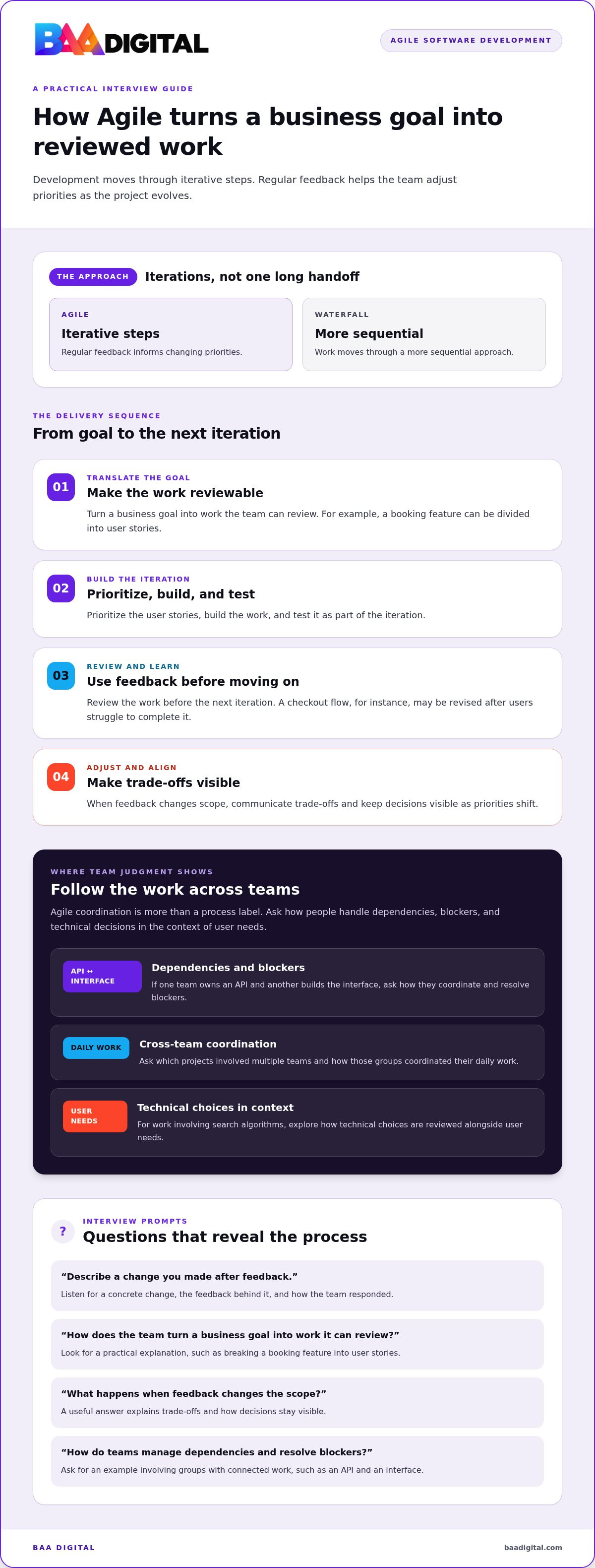
Agile work breaks development into iterative steps, using regular feedback to adjust priorities. The Manifesto for Agile Software Development favours iterations over a waterfall approach, where work moves through a more sequential process. Ask candidates to describe a change they made after feedback, such as revising a checkout flow after users struggled to complete it.
Ask how a team turns a business goal into work it can review. For example, a booking feature might be divided into user stories, prioritised, built, tested, and reviewed before the next iteration. Then ask what happens when feedback changes the scope. The answer should show how the team communicates trade-offs and keeps decisions visible.
Cross-team work calls for specific questions during hiring. Ask which projects involved multiple teams and how those groups coordinated their daily work. If one team owns an API and another builds the interface, ask how they manage dependencies and resolve blockers. For projects involving search algorithms, ask how technical choices are reviewed alongside user needs.
Ask how software development costs in the Philippines are estimated and which factors can change the estimate. Cost depends on project scope, integrations, testing, team capacity, and maintenance. A quote request provides the price in PHP.
Use a practical scenario to explore the candidate’s approach: a feature passes review, but user feedback reveals a confusing step. Ask what they would investigate first, who they would involve, and how they would decide what to change. A clear answer connects feedback to a decision, then explains how the team would test the revision and share the outcome.
These questions help distinguish Agile practice from process labels. Listen for examples of feedback, prioritisation, and collaboration, rather than a rehearsed description of ceremonies. Asking candidates how they handled a real change reveals how they adapt while keeping work aligned with its goal.
4. What technical questions should you ask a software developer in an interview?
Ask candidates to explain how they would choose a data structure for a real feature. Arrays, stacks, trees, and graphs solve different problems. For example, ask which structure might represent connected locations in a route planner, then invite them to explain the trade-offs. You’re assessing their reasoning, not just recall.
A short coding exercise can reveal how someone breaks down a problem. The Fizz Buzz challenge asks candidates to print numbers 1 to 100, replacing multiples of 3 with “fizz” and multiples of 5 with “buzz.” Ask them to talk through edge cases and test their solution as they work.
Whiteboard exercises and coding tests offer different signals. A whiteboard exercise shows how a candidate discusses a solution on paper, while an online coding test shows how they work in an editor. For either format, explain the task’s purpose and invite questions before they begin. Observe how they clarify requirements, choose an approach, and respond to feedback.
Ask how they test a change before release. For a price-calculation feature, ask how they would check rounding, tax inputs, and unexpected results. A useful answer explains which cases they would test and how they would identify a defect. Follow up by asking how source control helps preserve earlier code versions during a change.
To explore system design, ask a candidate to outline the steps for building a simple customer portal. The software development life cycle typically has six to seven steps, from brainstorming through ongoing product maintenance. Ask where they would gather requirements, test, and plan maintenance. Their sequence can reveal whether they consider the full product lifecycle.
Keep the interview focused on the work your project needs. If a clear product direction is still taking shape, explore content and digital strategy to help define goals and requirements before development begins.
BAA Digital: Custom Systems & Web Apps
BAA Digital helps businesses turn operational requirements into custom systems and web apps. This is a natural next step when your team needs software tailored to a specific workflow rather than a general interview checklist or an off-the-shelf process.
Its work also includes AI Tools & Automation, Business Websites & eCommerce, and Business Process Solutions. These offerings can support projects that connect business processes, customer-facing websites, and tailored digital tools. A clear project brief, key user needs, and the workflow you want to improve will help define the right direction.
If you’re ready to discuss a digital project, contact BAA Digital to start the conversation.
Turn Your Developer Search Into a Clear Project Plan
Turn interview notes into a practical decision. Record the needs your team must address, the people who will use the solution, and the decisions that still need an owner. This gives your chosen developer a useful starting point and keeps early discussions focused on delivery rather than assumptions. The questions to ask a software developer are most useful when they connect directly to what your business needs to build.
For projects that need tailored digital tools, BAA Digital offers Custom Systems & Web Apps, AI Tools & Automation, and Business Websites & eCommerce. The right starting point depends on the workflow or customer experience you want to improve.
Contact BAA Digital to discuss your project and take the next step with a clearer plan. A focused conversation can help turn your priorities into a practical direction.
Frequently Asked Questions
Do you consider unit testing essential, or a waste of time?
Unit testing is useful when it checks important behaviour that could break during future changes. Ask how the developer chooses what to test and how tests fit into code updates. For a discount function, a focused test could check eligible purchases, excluded items, and boundary conditions. Tests are less useful when they only duplicate implementation details and fail whenever internal code changes.
How would you explain APIs to non-technical stakeholders?
An API is a defined way for software systems to request and exchange information. A developer might explain it as a restaurant menu: it shows what can be requested and what information comes back. For a delivery service, an order system could request a shipment update through an API. Ask what happens when a request fails, and listen for a plain explanation of the impact on users.
What do you think are the most important aspects to pay attention to when reviewing another team member’s code?
Review code for correctness, clarity, and fit with the project’s existing patterns. Check whether names make the intent clear, errors are handled, and changes avoid exposing sensitive information. For a new account form, consider invalid inputs and duplicate submissions. Useful reviewers explain concerns with a concrete example and suggest a way forward, rather than focusing on personal style preferences.
What questions should you ask a software developer before hiring?
Ask how the developer will communicate decisions, handle changing requirements, and document work your team will need later. Clarify who approves changes and how unresolved choices are escalated. For example, if a requested feature affects an existing workflow, ask how they would explain the trade-off before proceeding. These questions reveal whether expectations and responsibilities are likely to stay clear during delivery.
What questions reveal a software developer's experience and past projects?
Ask the developer to walk through one project from the original need to its final use. Find out what they personally built, which constraint shaped their approach, and what they would do differently now. For a customer portal, ask how they handled a difficult user journey or integration. Specific details about decisions and lessons help distinguish hands-on experience from familiarity with a project’s headline.

